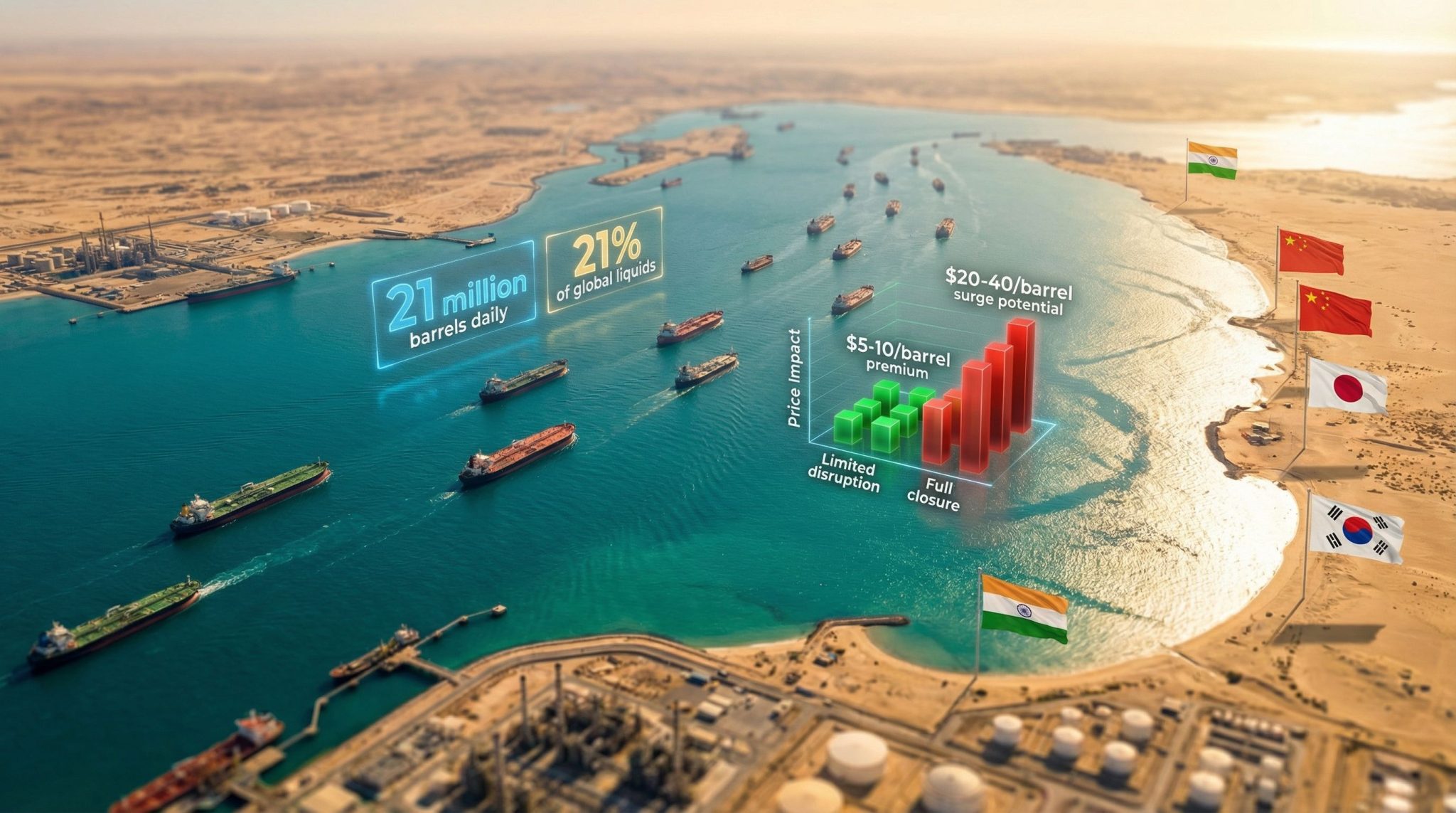
What happened
The European Union has cut its 2026 growth forecast as the crisis in the Strait of Hormuz pushes inflation higher, according to Euronews on 2026-05-21. The same day, PubAffairs Bruxelles said EU trade ministers were set to review economic security and the impact of the conflict in the Middle East on trade at the Foreign Affairs Council in its Trade configuration on 2026-05-22.
That combination matters because it shows the EU treating a distant security shock as an immediate economic-policy problem. The search results also show that European institutions are already using the language of economic security, supply-chain resilience, and trade disruption rather than only traditional foreign-policy framing.
Why it matters
Europe’s vulnerability in this moment is not simply that a regional conflict has raised prices. It is that the shock is moving through the EU’s core strategic dependencies at once: energy, shipping, industrial inputs, inflation expectations, and growth policy. When a bottleneck such as Hormuz disrupts flows, Europe does not face a single-sector problem; it faces a transmission mechanism that hits households, manufacturers, and central banks simultaneously.
That matters geopolitically because Europe’s foreign policy choices are increasingly being shaped by economic exposure. The EU can endorse de-risking, strategic autonomy, and resilience, but a real energy shock forces those concepts into budget debates, trade policy, and industrial policy. In practical terms, the bloc’s ability to sustain support for external commitments often depends on whether its internal economy can absorb imported volatility.
Key facts
- The EU cut its 2026 growth forecast as the Strait of Hormuz crisis pushed inflation up, reported by Euronews on 2026-05-21. (Euronews, 2026-05-21)
- EU trade ministers were scheduled to review economic security and the Middle East conflict’s impact on trade at the Foreign Affairs Council in Trade formation on 2026-05-22. (PubAffairs Bruxelles, 2026-05-18 to 2026-05-31 forward look)
- The same Council session was also expected to discuss WTO reform and ongoing trade negotiations. (PubAffairs Bruxelles, 2026-05-18 to 2026-05-31 forward look)
- Agriculture ministers were due to discuss the availability and affordability of fertilisers in the EU. (PubAffairs Bruxelles, 2026-05-18 to 2026-05-31 forward look)
- The forward look also placed economic security and the impact of Middle East conflict within the EU’s broader policy agenda for the fortnight. (PubAffairs Bruxelles, 2026-05-18 to 2026-05-31 forward look)
Analysis
The significance of this story is that the EU is being forced to govern as if energy geopolitics and macroeconomic stability are the same file. That is a major shift from the era when Europe could assume global shipping lanes were functionally stable and that external turmoil would arrive only as a slow-moving diplomatic problem. A Strait of Hormuz disruption is different. It can affect prices quickly, alter expectations even faster, and weaken the political room available for fiscal restraint, industrial policy, and climate-transition sequencing.
The immediate consequence is likely to be a more explicit fusion of trade policy and security policy. The Council’s focus on economic security, coupled with the review of the Middle East conflict’s trade effects, suggests that Brussels is adapting its institutional vocabulary to a more volatile world. Europe’s challenge is that resilience is expensive: diversification, stockpiles, alternative routes, and industrial redundancy all reduce vulnerability but raise costs. That trade-off becomes especially acute when inflation is already under pressure and growth forecasts are being revised lower. In other words, Europe is not just responding to a shock; it is being pushed to choose what kind of economic power it wants to be.
There is also a broader strategic implication for transatlantic and global trade politics. If Europe interprets Hormuz disruption as a test of economic security, it will likely accelerate efforts to reduce single-route dependencies and strengthen market access safeguards. But the EU’s room to maneuver remains constrained by the same interdependence it is trying to manage. Imported energy, fertilizer affordability, shipping costs, and industrial competitiveness are linked. That means one regional conflict can reshape debates far beyond the Middle East, including how Europe balances openness with protection, and how it prioritizes resilience over efficiency.
What to watch
- Forecast: EU institutions may widen the use of “economic security” language in trade and industrial policy as energy shocks continue to affect growth and inflation.
- Forecast: Member states exposed to higher energy and import costs may press for faster diversification measures and more support for vulnerable sectors.
- Forecast: If Hormuz-related disruptions persist, the EU’s policy debate could shift further toward supply-chain resilience, storage, and strategic redundancy rather than short-term price relief alone.
What happened
A more immediate policy signal came from Brussels on 2026-05-22: EU trade ministers were due to examine how the Middle East conflict is affecting trade, alongside WTO reform and ongoing trade negotiations, according to PubAffairs Bruxelles. The agenda also included an economic-security review, underscoring that the EU is now treating external volatility as a central trade-policy issue rather than a peripheral shock.
The Euronews report from 2026-05-21 makes the consequence visible: the EU has already lowered its 2026 growth outlook because the Strait of Hormuz crisis is pushing inflation higher. That is a significant warning sign for a bloc that has spent years trying to reconcile green transition goals, competitiveness pressures, and strategic autonomy. The problem is not just higher prices. It is the way price shocks compress policy space.
Why it matters
Europe’s geopolitical predicament is increasingly defined by exposure to chokepoints. The Strait of Hormuz is not in Europe, but it sits inside the architecture of Europe’s economic security. When traffic through such a passage is threatened, the impact is not confined to energy traders. It ripples into household budgets, industrial margins, logistics costs, and central-bank expectations. That is why a regional conflict can become a European growth story almost immediately.
This matters because the EU’s grand strategic vocabulary has outpaced some of its practical insulation. Brussels has embraced the idea of resilience, but resilience only becomes real when institutions, firms, and governments can absorb disturbance without sacrificing core objectives. If inflation rises while growth slows, European leaders face a harder choice between supporting competitiveness, preserving social cohesion, and sustaining external commitments. The result is a more constrained Europe, even when it is trying to project more strategic confidence.
Analysis
The deeper strategic story is that economic interdependence no longer looks like a neutral force. In a low-friction world, trade and energy flows were treated as background conditions for politics. In the current environment, they are instruments through which geopolitics is felt directly inside the European economy. That means Europe’s response to external shocks cannot be purely diplomatic. It must be structural: supply diversification, better trade-risk mapping, and more robust coordination between energy, industrial, and foreign policy.
The Council’s agenda shows Brussels moving in that direction, but also reveals the scale of the task. Economic security is now being discussed alongside WTO reform and trade negotiations, which suggests the EU still wants to defend openness even as it hardens the system against coercion and disruption. The difficulty is that more protection usually means more cost, and more cost can weaken public support for strategic adaptation. Europe’s real test is whether it can build a resilient economy without turning resilience itself into a drag on growth.
What to watch
- Forecast: Further inflation pressure could push EU institutions to emphasize economic security in future Council sessions and trade talks.
- Forecast: Energy and logistics vulnerabilities may become more prominent in European industrial policy debates if the Hormuz crisis continues.
- Forecast: Growth revisions or weaker business sentiment would likely intensify pressure for coordinated EU measures on resilience and competitiveness.